Archive for the ‘News’ Category

posted by admin on Jan 11

http://www.goldstreamgazette.com/news/135262748.html

Bike rentals free at Eagle Ridge

By Edward Hill – Goldstream News Gazette
Published: December 09, 2011 9:00 AM

Langford residents can now cycle city bike lanes and trails for free, thanks to a bike borrowing program run out of City Centre Park.

Residents can check out one of 10 cruising or mountain bikes for free up to three hours, and then pay $3 per hour after that. Non residents will pay $3 per hour.

“This is to encourage cycling and use of city parks and bike lanes,” said Mike Leskiw, manager of Langford parks. “People can bike from here to downtown or Goldstream park. It gets people out in the neighbourhoods.”

The free bike program ties into Langford’s multi-year project to build more bike lanes and separated bike paths to connect the city core with outlying neighourhoods.

The free bike program is run out of Eagle Ridge arena and started recently, coinciding with the official opening of the Sportsplex and the completion of City Centre Park.

Langford residents will need to show proof of residence in Langford, such as a driver’s licence or a utility bill. Anyone borrowing a bike will also need to leave a credit card to ensure the bike returns.

The city has installed a number of digital signboards which highlight bike lanes and paths around the city.

“I think it will be used quite a lot as the word gets out there,” said Gerry St. Cyr, manager of City Centre Park. “Anyone can try it out. A parent can bring their child and hop on a bike, pick a route and go.”

posted by admin on May 12

Blasting causes headaches for Langford homeowners

Posted By: Danielle Pope

05/11/2011 12:00 AM

http://mondaymag.com/articles/entry/blasting-causes-headaches-for-langford-homeowners/

Langford has no control over blasting, says city planner

When Derek Galon and his wife Margaret first heard the explosion that made their house shudder, their dishes shatter and pictures shake off the wall, they thought it was an earthquake.

The couple had lived in their Langford home on Walfred Road for eight years and had never felt anything like it. Moments later, they realized it was a construction blast from the developers at a neighbouring property. What they didn’t know then was that it would be the first of many for at least the next four years — and that slowly those blasts would destroy their 1970s house.

“I’ve lived through many upheavals and even civil threats in my life and it’s not easy to put me on edge, but this is very stressful,” says Galon, 54, who’s originally from Poland. “Part of the reason I moved to Canada was because of its beauty and calm environment, but the total disrespect I see for nature and for others is shocking and saddening. People here think they can do whatever they want.”

The Galons have been living with a single blast a week to three blasts a day since 2007, when the property development began. There is no warning. While the disturbance was clear from the get go, Galon first noticed structural damage to his home only a few weeks after the blasts started, when a large crack appeared in his living room ceiling. Since then, Galon has seen cracks in the exterior and interior walls, his chimney and in the cement foundation of his house.

Galon remembers the quiet setting, the thick trees, the wildlife that would scuttle past and the choir of birds that would accompany the family every day when he and his wife moved in back in 2003. Now, they’re considering selling the home they spent their lives looking for.

“We are being surrounded by new development and it’s totally changing the look of the neighbourhood,” he says. “We see our neighbours selling their houses and the atmosphere has lost its appeal to everyone.”

Galon isn’t the only neighbour in the Walfred area who is suffering the effects. Len McIlwrick, 53, has lived in the area since 1990. While he says his house has not suffered any damage, his property, tree line and peace of mind has.

“Usually, Langford never says no to anything when it comes to development, and that’s part of the problem,” says McIlwrick, who adds that he supports development on a whole. “They’ve been blasting 40-feet into the rock on the edge of my property, you hear drilling and blasting all day sometimes, and you just have no idea what you’re in for.”

McIlwrick had a technician associate who works with sound actually measure the decibels that came from the construction. He found that the Sound Pressure Level (SPL) meter rated the blasts at 101 db from over 100 feet away — something akin to standing next to a subway train.

“All of these developers seem to operate by telling you it’s all within code and ‘we’re not as bad as the other guy,’ but that’s just how it starts,” says McIlwrick. “Now, I’m experiencing mini-earthquakes every day, and I have 100-foot to 150-foot trees on my tree line — these beautiful 200-year-old cedars — with half their roots missing because the developers cut them back.”

McIlwrick says he has been offered over $1 million for his site, but refused the offer outright. While he is concerned about the trees, increase in traffic, population density and the continued destruction, he plans on waiting it out.

Paul Emery of Gem Garden Homes is one of the lead developers on the Walfred site near McIlwrick’s house. The feedback that he’s heard from neighbours, he “wouldn’t class as complaints,” and says he has “no problem” with the blasting his company does, adding that some companies are much worse. However, he does acknowledge that some residents are put out.

“There are some neighbours here who are not happy with the changes, and they’re planning on dying here, so there’s not much chance they’ll be selling anytime soon,” says Emery. “But they aren’t going to like it no matter what happens, and that’s really too bad.”

Emery lives on-site in one of the newly constructed homes. He says he’s had blasting done within one metre of his location and has never experienced a problem. He does admit that blasting can affect a house, but that engineers are used to ensure the impact is unnoticeable.

“I’ve been there for five years with this project, and I’ve been around construction my whole life so it doesn’t bother me. It’s something you just have to deal with for a little while, and then it’s over. We’ve achieved our goal here.”

Emery says he’s not willing to discuss the tree-root incident, though he says it has been resolved and adds that “there are always three sides to every story: yours, theirs and the real story.”

“For sure the neighbourhood has changed, but all of it is in good ways. Now we have nice, affordable housing in a great neighbourhood,” Emery says. “Naturally, you’re going to get people’s backs up because people don’t like change, but Langford is a great destination.”

When it comes to help from the city, both Galon and McIlwrick say they’ve pleaded with Langford City Council and other city officials countless times with little traction.

While the regional council members refused to speak on the issue, Matthew Baldwin, Langford city planner, says that the city recently granted a temporary permit for the developers to find ways to dispose of the debris caused by blasting, but adds the city has no control over the blasting itself.

“[Blasting] is provincially regulated by WorkSafe B.C., and by the insurance companies,” says Baldwin. “The city does not regulate blasting and has no control over it.”

Baldwin acknowledges that some residents have attended council meetings to complain about the blasting and have informed council of the damage to their properties that they believe is from the blasting. However, Baldwin says there is little evidence to prove that is so.

“The sites have been developed according to the official community plan,” Baldwin says.

When asked for further details of what the official community plan involved, Baldwin refused to comment, and said he has “no idea where things are going” and “cannot predict the future.” Baldwin has been the city planner since 2008, and must approve all proposed city developmental plans. He also stated “I’m not answering that question” when asked about his thoughts on how the developments on Walfred Road are affecting the municipality, though he did later state that the blasting and construction has not affected him personally.

“Langford has more park and open space than a lot of other municipalities in B.C.,” he says. “You do have people impacted by blasting, but it’s a necessary part of developing land. The owners of the properties are entitled to do what they want with their land. The blasting is a matter between two parties — the developers and the residents.”

Galon has had an insurance agent out to his property multiple times, though he has been advised to wait on repairs until the neighbouring construction is finished — so far, that time line for completion is unclear. He’s also had a geo-engineer inspect the seismic damage inflicted by the blastings, and learned that while many blasters work within ground vibration levels of zero to 15 millimetres per second, some heritage houses will crack at levels of five or less.

While the neighbours are collectively considering legal action, the lack of support municipally has been a deterrent. Galon says, if nothing else, he wishes to highlight the effects of this type of construction, both for the current residents and for others in a similar situation.

“I think the most painful thing to watch is the total disrespect to surroundings, be it to wildlife, landscape, or neighbours,” he says. “If a developer lacks the vision to see the beautiful potential of an area, it should be the role of the city to control and promote such values. Without it, there will always be silly people just looking for a quick money grab that proves disastrous for the whole neighbourhood in the long run.” M

posted by admin on Apr 26

By Edward Hill – Goldstream News Gazette
Published: April 21, 2011 11:00 AM
Updated: April 21, 2011 11:25 AM

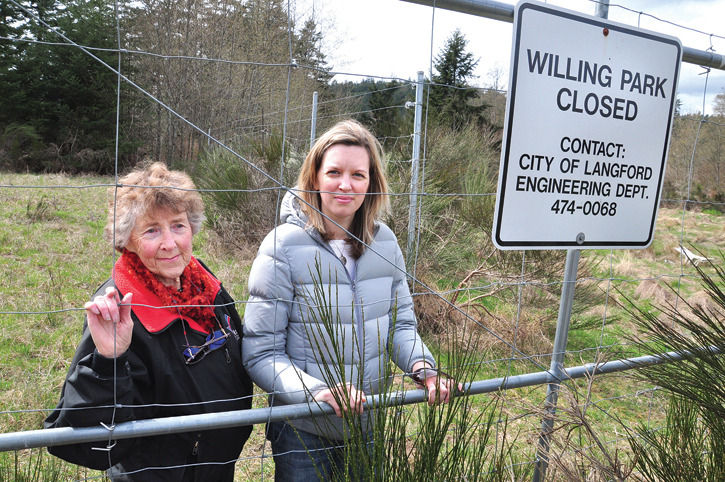
Christina Willing opens the tall wire gate to what was once a community garden, now overgrown with broom and largely forgotten. She scowls at a sign that reads “Willing Park Closed.”

About 10 years ago the garden was abandoned, although the tall deer fencing and a broken down shed remains. But with homes and townhouses cropping up next door in Valley View Estates, Willing wants the community to get better use from the park that bears her family name.

“We already have a fenced in area for a garden. The rest is a natural area enjoyed by animals and birds,” says Willing, as she walks through a pasture that was once part of her family’s dairy farm.

“I’d like to see a garden and community trails. It’s a place people can go as a family and have a picnic in a natural area. There are all kinds of possibilities.”

More than 12 years ago Willing and her late husband donated about five acres to Langford, and the City purchased the rest to create 14-acre Willing Park, a public greenspace that, despite the initial stab at gardening, has remained idle and little known.

Willing, 85, has walked the property almost every day since settling on the farm in 1945. A stream cuts the rough land under a canopy of alder and cedar trees. It remains home to chirping birds and deer, and in earlier days, the odd bear and cougar.

Melanie Willing, the wife of one of Christina’s grandsons, says as higher-density housing becomes the norm across Langford, the demand for community gardens will only increase. A decade ago, the land next door was a chicken farm, now it’s a growing residential neighbourhood.

“The numbers (of people) are here now. There’s lots of homes with little or no yard,” Melanie says. “Langford’s focus is big box shopping and all the amenities, which is great. Still there is room for heritage agriculture and farming.”

“We need people interested in it and not to leave it. It is a valuable piece of land as far as agriculture goes. It’s very good soil,” the elder Willing says. “If you look at the community now, houses lack any type of garden. And people are becoming more interested where their food comes from.”

Langford Coun. Lanny Seaton, chair of the parks and recreation committee, admits that indeed, the City doesn’t have any plans for the greenspace.

At one point part of the park was eyed as a place to run dogs, and rough measurements were made to see if ball diamonds would fit, but nothing is on the table.

“We’ve been so busy with the Sportsplex and the new fields, that’s really taken a lot of energy and resources,” Seaton says. “If we were to do something (with Willing Park), we’d get together with the community.”

The fenced-off garden has no running water or power to run a well, he noted, making a potential community garden more difficult to maintain.

“I could see a community group running (a garden),” Seaton said. “Our vision is to keep it open and wild. But it’s good property, and we’re holding onto it, but we have no real plans for it.”

Ideally, the Willings would like to see it left wild too, although with a few maintained walking trails and places to have a picnic. Access is better too, they say, since the completion of Frederic Road off Willing Drive. People can also access the park off Wild Ridge Way.

“I want it developed into a park while I’m still here,” the elder Willing said. “People need a place to go where there is peace and quiet, especially these days. I’d love to leave some places around so my grandchildren and great-grandchildren can enjoy the outdoors.”

Holding her young daughters’ hands, Melanie agrees, and hopes people will step forward to help re-establish the community garden.

“The neighbours have no idea it’s here. It’s so hidden away,” Melanie says. “I hope people in the community become aware of this hidden little secret.”

Anyone interested in a community garden at Willing park can email Melanie Willing at mkwilling@hotmail.ca.

posted by admin on Aug 14

Manufacturing our local landscapes

Published: August 03, 2010 1:00 PM

A native black-cap bush used to grow beside the road just along from my place. It yielded tasty berries unlike anything you can buy.

To me the bush seemed such a treasure that in a dry August I carried buckets to water it. So I was shocked to see one summer morning that a neighbourhood-improver had tidied the road margin by leveling the ground and rooting out all vegetation, including my valued black-cap, for a couple of square metres.

Walking past the patch of brown goat pasture where the black-cap used to grow, I am troubled by the sense of loss that bites me when someone spoils the local mini-landscape.

I felt that kind of dismay on a larger scale when I looked out the window of the No. 58 Langford Meadows bus and saw a tract of seasonal wetland at the foot of Langford Lake advertised for sale or lease — presumably to be developed and paved over, like other wetlands in this lake’s tiny watershed and flood plain.

The advertised stretch of land includes a trail bordered by a thick hedge of blackberry bushes — a trail which some of us simple-minded, unwary people imagined was public property. Linked to the trail that skirts the lake is a thin fringe of woodland screening off the general expanse of concrete.

People gather hundreds of pounds of blackberries on the auxiliary trail that lies on the land now advertised for sale. Couldn’t something be done to save this source of food close to home? Buy and keep the land as a public trust, maybe?

I know other people who feel a sense of loss in a variety of contexts. Along the stretch of Wishart Road that fronts on the federal woodland adjoining Royal Roads University, for example, some people are seriously bothered because Colwood municipality has filled in a grassy ditch or small valley which used to be the perfect place to walk a small dog.

Now it is just a flat, sterile stretch of gravel. Did the municipality really save money on cutting the grass within that miniature valley, by filling it in? Several residents of Wishart have been unable to get city hall to answer that question, or pay any attention to their complaints.

This issue may seem trivial. But it is a sign of the coarse texture of local politics, the insensitivity of local government to the feelings of citizens. This blurred connection is especially troublesome on the boundary between human settlement and wild nature — if those realms really are separate from one another.

One trend of thought suggests that wild areas are no longer truly wild, and the whole planet has become one zoological garden, destructively mismanaged by its human keepers.

The high fence that used to enclose that stretch of woodland on Wishart — too high for deer to jump over — has been replaced by a low barrier. It’s an easy jump, so deer routinely cross over and browse on the neighbourhood gardens.

Deer have become halfway domestic animals, as expanding residential development invades their habitat, and there are no cougars to thin their numbers. They are a pretty sight, grazing along the edges of golf courses and in our remaining tracts of woodland.

But they make trouble for themselves and humans when they crowd across roads and cause traffic crashes. What are we supposed to do about all that? Humane birth control may be the answer. For deer and rabbits you do it by capture; for people, by persuasion.

Zero growth — the steady-state economy — is strongly argued in the current issue of New Internationalist magazine. Population control is part of the design for reducing world poverty while cooling and reversing the doctrine of growth which, ecologists contend, is killing the planet.

—G.E. Mortimore is a Langford-based writer. Think About It runs every second week in the Gazette.

http://www.bclocalnews.com/vancouver_island_south/goldstreamgazette/opinion/99837539.html

posted by admin on Jun 28

Connecting science and art

Focus Magazine July 2010

BRIAN GRISON

When the Garry oak meadows of Langford were threatened, naturalist Fran Benton turned to art and politics.


Considering that she is an artist, it is interesting that Fran Benton’s first passion is natural history, a branch of science. With a degree in biology and geography from the University of Victoria, her original career was field biology and park-naturalist. As a matter of fact, Fran Benton “discovered” art through the necessity to improve her drawing skills for her scientific research. As she explains: “Almost all field biologists have a bit of art training, as we often need to draw the plants, geography, and animals we work with. Because I already did a lot of fun art stuff as a kid, I enjoyed drawing for my fieldwork….[ For a time I had] a job at the Swan Lake Nature Sanctuary. Since we had no illustrations in the nature centre, I started to make drawings and paintings for the centre.” But with no art training, she says she found her work “unsatisfactory.”

Thinking like a scientist, and without a conscious decision to pursue an artistic practice, Fran Benton changed her work schedule so she could attend the two-year art program at Camosun College, to learn to draw plants properly. Even though Camosun College did not have botanical illustration courses, she says, “after two weeks I was hooked…I knew this was what I wanted to do for the rest of my life.”

After completing the Camosun College program, she earned a Batchelor of Fine Arts degree at the Emily Carr College of Art and a Masters in Fine Arts degree at UVic. She now teaches full-time in the Art and Design Department of Vancouver Island University in Nanaimo. While in a formal sense Fran Benton is no longer a field researcher in natural science, the spirit and intention of her art practice are the equivalent, and every bit as valuable to society and the local natural landscape.

In the early 1990s, Fran Benton and her husband moved from Saanich to their “first real home” in Langford, at the time, as she describes it, “a scruffy but charming suburb of Victoria with lots of beautiful wild areas.” Unfortunately, not long after their arrival in Langford, the recently-elected mayor embarked on huge land development projects that destroyed virtually all the beautiful and rare local Garry oak meadows; almost none of it was preserved as parks, bird sanctuaries or other natural spaces. Garry oak woodlands that had been cultivated by local First Nations people, as well as their spiritual sites, were bulldozed and replaced by all those “big box” stores surrounded by acres of parking lots that Langford is now infamous for.

Interestingly, but sadly, Fran Benton’s attempts to stop this destruction displayed the naiveté of the scientist who believes that simple rational argument must naturally change the mind of even the most crass politicians and developers. Thinking this was a “one-off kind of thing,” she organized presentations to council and the mayor. However, these government officials and politicians were “unconcerned with the voices of their constituents to slow down the development.” She then put up posters to educate her neighbours about the loss of wild places and natural landscape, trees, flowers and local animals in their community. Finally, because she realized that her mission was slowly driving her to despair, she turned to art as a more gentle tool of positive propaganda.

She developed projects to express and release her from the anguish she felt on behalf of the land where she lived. In one project she made little bags containing tiny ceramic claws as talismans accompanied by thank-you notes that she hung in trees she knew would soon be cut down. In the notes she explained to the trees that their services were no longer needed in the municipality of Langford; the tiny claws were the equivalent of the gold watch, that cheap symbol of forced retirement and arbitrary dismissal.

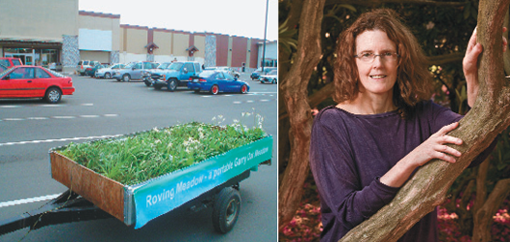
In another project, “Roving Meadows,” Benton set out to save some of the beautiful local plants. As an experienced and dedicated plant salvager and propagator— both as scientist and gardener—she had noted all the camas lilies and other plants in a 30- acre Garry oak meadow near her house that was being surveyed for a shopping mall. She received permission to explore the meadows. She was seeking a small plot that she could remove as a single block of earth, with all the flowers and plants in place. Once she found it, she carefully transplanted the whole block on a four-by-eight-foot trailer.

Several months later, when the shopping mall was complete, she drove the trailer-cumplanter to the exact spot where it had grown before the new parking lot smothered everything natural. She spent an afternoon giving away plants and cuttings, and handing out pamphlets that explained the necessity to save a small section of that meadow in a giant flower box. Later, the Swan Lake Nature Sanctuary agreed to plant the little section of homeless meadow in its own beautiful park.

Eventually Langford became so unwelcoming that Fran Benton and her husband sold their house and moved to a quiet street in a beautiful, naturally-landscaped neighbourhood in Mill Bay. Her whole high-ceilinged basement is a busy art and study centre where she continues to make art that honours both the beauty of the natural world and her scientific/political advocacy for it.

Brian Grison is a Victoria based artist, art teacher and writer.

posted by admin on Apr 26

anonymous wrote:

The following is a one-paragraph excerpt from the April issue of FOCUS Magazine by Gordon O’Connor p.15 who is the forest campaigner with the Dogwood Initiative. It just applies so beautifully to Langford that one cannot help but think of Langford while reading it.

“Vancouver Island is one of the crown jewels of this continent. It is widely considered to be among the most liveable places in the world. If offers the luxury of having urban centres in close proximity to temperate rain forestsbountiful farms and incredible recreation areas. This pristine environment has the ability to provide clean waterfresh airlocal food and a stable economy for generations to come and these are the priorities for which our local representatives [read councillors] should be advocating.”

(bold emphasis and [comment] are mine)

posted by admin on Mar 16

Former agricultural land to become subdivision in Langford

BY BILL CLEVERLEY, TIMES COLONISTMARCH 16, 2010


A 501-unit subdivision on a 13.9 hectare parcel at 936 Flatman Ave. was given Langford council’s blessing Monday night following a low-key public hearing.

To be known as McCormick Meadows, the proposal made by architect Herbert Kwan for Sydney and Gay McCormick, is to create 102 single family lots, 61 townhouses and 338 apartment units in five buildings of up to six storeys on the formerly agricultural land.
Read more: http://www.timescolonist.com/travel/Former+agricultural+land+become+subdivision+Langford/2689931/story.html

RELATED: Houses planned for farmland

posted by admin on Mar 9

Happy Valley Lavender & Herbs | 3505 Happy Valley Road | Langford | Telephone: 250.474.5767

The Happy Valley Lavender Farm celebrates 100 years this March 23 2010! One wonders what Lynda Dowling’s grandfather was thinking during his humble start walking the E & N (now Galloping Goose) Railway line to check out this property in 1910 …

By 1925 he had married Lynda’s grandmother after meeting her at Witty’s Lagoon on a church picnic! At that time he was a gentleman farmer originally from England. He served on the local Metchosin Farmers Institute and School Board.

Lynda’s grandmother, also from England, soon became famous for her Strawberry & Raspberry teas and cakes with the Woman’s Institute. Lynda remembers there always was an apple pie on the back of her grandmother’s black & silver wood stove…

Happy Valley Lavender’s current Herb & Lavender garden theme began in 1983. Lynda moved onto the family farm in 1986 with an English husband and 10 month old son. She felt like she had come home, with all the neighbours she knew from childhood times. Lynda’s grandmother would have loved her gardens, particularly all the Sweet Lavender like England.

If you remember Lynda Dowling’s grandparents, please share your memories with her as they celebrate the centennial of their family farm. It’s their 22nd year of harvesting Lavender as a crop, and a great time to come check out their secret sanctuary gardens and nursery behind Lynda’s grandfather’s daunting cedar hedge!

http://www.happyvalleylavender.com/lavender_harvest.html#grandfather

posted by admin on Feb 18

Farmland freeze needed now

G.E.Mortimore

From the Lower Island News, April/May 2010

B.C.’s Agricultural Land Commission has a moral duty to guard and improve the food supply.  So why do the commissioners shirk their duty?

The law allows removal of pieces of land from the Agricultural Land Reserve (ALR) for well-documented reasons, but its main purpose requires commissioners to safeguard food-producing capacity and encourage farming.

Commissioners ignore that order. They let builders pave over big chunks of foodland.  The loss of  land has become so painfully obvious, and the need for nailing down a close-to-home food-supply system in a changing world has become  so urgent, that the commissioners now have only one honourable and practical choice:  To freeze all applications for removal of land from the ALR province-wide, until food-growing policy is sorted out by a public enquiry and action plan. A three-year brainstorm-break seems reasonable.

Between 1975 and 2003 the commissioners approved a net decrease of 35,500 hectares, 87,720 acres, in the reserve farmland of the Okanagan, the Fraser Valley and Vancouver Island. On the Island alone, the decrease was 12,797 hectares.

In the part of B.C. where most of the people are concentrated, the shrinkage of  foodland has continued at a fast rate since 2003, and a thick file of convoluted arguments for ALR removal, couched in planning jargon, has accumulated in Langford, Cowichan and other Island places.

It’s time for commissioners to stand tall and really do their protective job, rather than just pretending to do it – a pretence that involves surrender to Premier Gordon Campbell. The Campbell government weakened the protection of foodland by splitting the commission into six regional agencies, each with the independent power to say yes or no to applications for removal.

The old province-wide solid group of land judges, or quasi-judges, stemmed the loss of prime farmland, which was bleeding away at 6,000 hectares a year when the Dave Barrett NDP government created the ALR in 1973. Premier Campbell sliced open six arteries and started the bleeding again.

Governments of all colours share some guilt for this disaster. “Liberals,” Socreds and NDP have all intervened at the top level, to curry favour with pave-it-over campaigners.  But Premier Campbell, the present culprit, is the worst offender. His fragmented panels, which meet separately and do not consider removal applications as a united body, have shown how vulnerable they are to pressure from municipal councils and land-speculator/developer lobbyists.

Arguably the lobbyists could make more money if they waited and thought longer, resisted sprawl which causes long-term expense to taxpayers, and concentrated development in high-density mixed-use nodes where big buildings could be insulated by rooftop gardens. Developers and land speculators are impatient, but it’s the job of the ALC to cool and re-direct the natural quick-money impulse. The scattered ALC tribunals should now join in a united front to support the long-term provincial interest, which takes account of great-grandchildren as well as contemporary yearners for wealth and comfort.

Might commissioners be politically punished for doing their job too well? They have little to fear. Arm’s-length agencies now have power to shame governments if they commit blunders, arrogances and sneaky tricks. Auditor-General John Doyle skewered Campbell and colleagues for violating the public interest when they gifted a forest corporation with millions in taxpayers’ money and trashed land-use and forest-conservation planning on a large tract of southwestern Vancouver Island.  Foodland guardians who show quiet courage are unlikely to get even a slap on the wrist from a government that seems headed for lame-duck status despite the long distance to next election.

“Food security” is a great slogan. It means growing food close to home. But unless we match actions to words, mouthing the slogan is a waste of breath. We need that three-year freeze on ALR removals, so we can feel our way into the evolving city-green design.

It isn’t just about commercial farms. Current eco-pressures – looming hikes in the cost of oil-driven long-distance food transport, climate change, economic hard times, numbers of fat couch-potato kids –  challenge land commissioners and all of us to brainstorm varied food-production patterns.

These range from high-intensity urban organic farms to rooftop vegetable beds above shoppping-mall/condo complexes, and networks of neighbourhood gardens protected within the ALR.

Healthful food for two daughters was among Michelle Obama’s reasons for planting a vegetable garden on the South Lawn of the White House. This rerun of Eleanor Roosevelt’s 1943 Victory Garden was partly driven by Mrs. Obama’s experience as a working mother when she sought a nourishing menu for Malia and Sasha, Marian Burros reported in The New York Times.

“Eating out three times a week, ordering a pizza, having a sandwich for dinner all took their toll in added weight on the girls, whose pediatrician told Mrs. Obama that she needed to be thinking about nutrition.”  Within months the girls shed weight.

Twenty-three fifth-graders from a nearby school will cultivate the garden, alongside the Obamas. The U.S. president will pull weeds. Sure, he has other things to do, but he needs his exercise.

Derelict car factories and abandoned houses and yards in the downsized automobile city of Detroit will be converted into mushroom sheds and urban farmland.

Hantz Farms will plant crops on 5,000 acres within Detroit’s city limits. The greening of Motown is one of many true stories about today’s trend toward growing food close to home.

City-green is maturing into a mainstream political force. Does this mean strong, decisive action, or gradual change in food habits, one family at a time?  Both.  One won’t work without the other.

We need to add to the ALR, not reduce it. Soil quality is not crucial. Refugees on the Aran Islands off Ireland’s West Coast made soil for crops and pasture by laying sand and seaweed on solid rock. Greenhouses and roof gardens must import soil. Roof gardens insulate buildings, conserve runoff rainwater, and reduce air pollution and energy costs.

Chicago has 2,500,000 square feet of green roofs, more than any other U.S. city. The green starts with a demonstration garden on the roof of Chicago City Hall. The city makes grants of $5,000 toward roof-gardens.

We need urban space dedicated to food-growing, from roof gardens to community garden-patches and plantations and orchards that supply food banks; and we need a political mindset that encourages such projects.

The rescue of 9.3 acres of endangered Saanich ALR food-land is a success story in the struggle to protect the food-production system from raids.

In 2001 the Capital Regional District, the owner of the Haliburton Road land,  was going to push its removal from the reserve and sell it for building 24 to 26 houses; but the Land for Food Coalition and the Cordova Bay Association for Community Affairs persuaded Saanich to buy the tract for $400,000. and keep it green, with side-by-side commercial farms, gardening and cooking school and community organic farm staffed partly by volunteers.

A more loose-jointed but equally valid agricultural model is under threat in Happy Valley and Luxton, in the Victoria suburb of Langford, where developers have filed applications to take a number of food-land tracts out of the reserve and build hundreds of houses, hived away from a diminished array of food producers by “edge planning,” the currently fashionable Plannerspeak phrase.

Luxton Fair and Luxton Market are the show-windows for growers of herbs, garlic, tomatoes, strawberries and other crops in a district of mingled cottages, old farmhouses and horse barns – territory where a person used to be able to live in a garage while he built his dream-house.

Can this federation of small growers survive invasion by massed housing? ALC commissioners need the three-year time-out to find an honest answer.

Some people trust Langford city council to be the guardian that will purchase ALR farmland and keep it green, as Saanich municipality did for the Haliburton land. Hostile critics object that in view of Langford’s pro-development record, such a move would be equivalent to putting the fox in charge oi the henhouse.

This point can be argued out. If the commissioners observe a three-year freeze on ALR withdrawals, however, the argument won’t matter.

The current commissioners who will hear applications for removal of Island lands from the ALR, Lorne Seitz of the Okanagan, Jennifer Dyson of the Alberni Valley and Niels Erik Holbek of Black Creek, are all commercial farmers. Their background may incline them to judge ALR land on a narrow conventional-farm basis, and to regard municipal councils (some of whom were elected by less than 25 per cent of eligible voters) as representing public consensus.

Both these ideas are outdated. The public and the commissioners would benefit if people urged the commissioners by snail-mail to reconsider their approach. Why not look them up and give direct persuasion a try? Making a pitch through the commission’s office has proved itself to be mostly a waste of time.  -30-

Both these ideas are outdated. The public and the commissioners would
benefit if people urged the commissioners by snail-mail to reconsider their
approach. Why not look them up and give direct persuasion a try? Making a
pitch through the commission’s office has proved itself to be mostly a waste
of time.

-30-

G.E. Mortimore, Ph.D., is a writer and social anthropologist based in
Victoria. Portions of this article have previously apperared as comment columns in
The Goldstream News Gazette.
posted by admin on Jan 25

http://timescolonist.com/business/Houses+planned+Langford+farmland/2479162/story.htm

TIMES COLONIST
JANUARY 24, 2010

Langford council is considering a proposal for a 501-unit housing development on land now zoned for agriculture.

The municipality’s planning committee will consider a staff report tomorrow on a development calling for 102 single-family lots, 61 townhouses and 338 apartments on the approximately 14 hectares at 936 Flatman Ave.

At least part of the property is in the Agricultural Land Reserve, which means the land use can’t be changed without approval from the provincial Agricultural Land Commission. The approval is critical for the development’s road access.

The report suggests councillors hold off until the Agricultural Land Commission weighs in.